
Areolar Reduction
What many women think of as "the nipple" is actually made of two parts: the nipple and the areola. The nipple is the projected part and the areola is the dark pigmented skin that surrounds the nipple. Their concerns are much more localized: they are unhappy with their nipples. Whether they are inverted or protrude too far or are too big or too puffy, these women are always excited to hear how simple it is to enhance just the nipple. And more beautiful nipples mean more beautiful breasts.
Some women may be displeased with the size of their areolae which may be enlarged due to genetic predisposition, previously having had large breasts then undergoing tissue loss, stretching of the areola due to implants, or other reasons. The areola reduction surgery is designed to remove the redundant areola tissue to improve the overall cosmetic appearance of enlarged areolae. The reduction may result in a slight lift and may also produce slight irregularities at the incision line if the reduction was significant
The Best Candidates for Areolar Reduction
Large areolas may look out of proportion with the rest of the breast-especially if the patient has had a breast reduction or breast lift, but it happens naturally as well (often after childbirth). There are no medical complications from having large areolas, so the desire to reduce the areola is purely cosmetic, but can really positively affect the patient's self-esteem and body image. 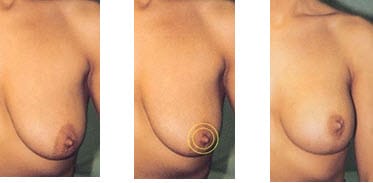
Type of Anesthesia
The aerolar reduction can be performed with local anesthesia combined with a sedative to make you drowsy. You'll be awake but relaxed, and your breast region will be insensitive to pain. (However, you may feel some tugging or occasional discomfort.)
The Surgery
All reductions begin with a doctor examination to determine the available options to achieve the desired results. Areolar Reduction is done by
removing some of the pigmented areola, either by an incision around the outside of the areola or by an incision around the base of the nipple.
Very large areolas may require a lollypop-shaped closure. This is where a vertical incision runs down from the nipple as well as around the
areola and then is closed in the shape of a lollypop.The goal is to minimize scarring and this is achieved by performing the smallest incision necessary. Dissolving sutures are placed underneath the skin - these minimize scarring as well as eliminate the need to come back into the office for a "painful suture removal day."The surgery usually takes less than one hour and the patient can return to their normal activities within a day or two. Sensitivity is usually maintained and all steps are taken to maintain the patient's ability to breastfeed.
After Your Surgery
Recovery time will depend on the patient, but most patients can return to work and resume their normal activity within a day or two.
This treatment does not normally affect the ability to breastfeed.