
Browlift (Forehead Lift)
A forehead lift or "browlift" is a procedure that restores a more youthful, refreshed look to the area above the eyes. The procedure corrects drooping brows and improves the horizontal lines and furrows that can make a person appear angry, sad or tired.
In a forehead lift, the muscles and tissues that cause the furrowing or drooping are removed or altered to smooth the forehead, raise the eyebrows and minimize frown lines. Your surgeon may use the conventional surgical method, in which the large incision is hidden just behind the hairline; or it may be performed with the use of special technique that allows the procedure to be performed with minimal incisions. Both techniques yield similar results -- smoother forehead skin and a more animated appearance.
The Best Candidates for a Forehead Lift
A forehead lift is most commonly performed in the 40-60 age range to minimize the visible effects of aging. However, it can also help people of any age who have developed furrows or frown lines due to stress or muscle activity. Individuals with inherited conditions, such as a low, heavy brow or furrowed lines above the nose can achieve a more alert and refreshed look with this procedure.
Forehead lift is often performed in conjunction with a facelift to provide a smoother overall look to the face. Eyelid surgery (blepharoplasty) may also be performed at the same time as a forehead lift, especially if a patient has significant skin overhang in the upper eyelids. Sometimes, patients who believe they need upper-eyelid surgery find that a forehead lift better meets their surgical goals.
Patients who are bald, who have a receding hairline, or who have had previous upper-eyelid surgery may still be good candidates for forehead lift. The surgeon will simply alter the incision location or perform a more conservative operation.
Remember, a forehead lift can enhance your appearance and your self-confidence, but it won't necessarily change your looks to match your ideal or cause other people to treat you differently. Before you decide to have surgery, think carefully about your expectations and discuss them in detail with your doctor.
All Surgery Carries Some Uncertainty and Risk
Complications are rare and usually minor when a forehead lift is performed by a cosmetic surgeon. Yet, the possibility of complications must be considered.
In rare cases, the nerves that control eyebrow movement may be injured on one or both sides, resulting in a loss of ability to raise the eyebrows or wrinkle the forehead. Additional surgery may be required to correct the problem.
Formation of a broad scar is also a rare complication. This may be treated surgically by removing the wide scar tissue so a new, thinner scar may result. Also, in some patients, hair loss may occur along the scar edges.
Loss of sensation along or just beyond the incision line is common, especially with the classic forehead lift procedure. It is usually temporary, but may be permanent in some patients.
Infection and bleeding are very rare, but are possibilities.
You can reduce your risk of complications by closely following your surgeon's instructions both before and after surgery.
Planning Your Surgery
For a better understanding of how a forehead lift might change your appearance, look into a mirror and place the palms of your hands at the outer edges of your eyes, above your eyebrows. Gently draw the skin up to raise the brow and the forehead area. That is approximately what a forehead lift would do for you.
If you decide to consult a cosmetic surgeon, he or she will first evaluate your face, including the skin and underlying bone.
During your consultation, the surgeon will discuss your goals for the surgery and ask you about certain medical conditions that could cause problems during or after the procedure, such as uncontrolled high blood pressure, blood-clotting problems, or the tendency to develop large scars. Be sure to tell the surgeon if you have had previous facial surgery, if you smoke, or if you take any drugs or medications -- including aspirin or other drugs that affect clotting.
If you decide to proceed with a forehead lift, your surgeon will explain the surgical technique, the recommended type of anesthesia, the type of facility where the surgery will be performed, the risks and the costs involved. Don't hesitate to ask your doctor any questions you may have, especially those regarding your expectations and concerns about the results of surgery.
Preparing For Your Surgery
Your surgeon will give you specific instructions to prepare for the procedure, including guidelines on eating and drinking, smoking, and taking and avoiding certain vitamins and medications. Carefully following these instructions will help your surgery and your recovery proceed more smoothly.
If your hair is very short, you may wish to let it grow out before surgery, so that it's long enough to hide the scars while they heal.
Whether your forehead lift is done in an outpatient facility or in the hospital, you should arrange for someone to drive you home after your surgery, and to help you out for a day or two.
Where Your Surgery Will Be Performed
A forehead lift is usually done in a surgeon's office-based facility or an outpatient surgery center. However, it is occasionally done in the hospital.
Type of Anesthesia
Most forehead lifts are performed under local anesthesia, combined with a sedative to make you drowsy. You'll be awake but relaxed, and although you may feel some tugging and mild discomfort, your forehead will be insensitive to pain.
Some surgeons prefer to use general anesthesia, in which case you'll sleep through the entire operation.
The Surgery
The classic forehead lift: Before the operation begins, your hair will be tied with rubber bands on either side of the incision line. Your head will not be shaved, but hair that is growing directly in front of the incision line may need to be trimmed.
For most patients, a coronal incision will be used. It follows a headphone-like pattern, starting at about ear level and running across the top of the forehead and down the other side of the head. The incision is usually made well behind the hairline so that the scar won't be visible.
If your hairline is high or receding, the incision may be placed just at the hairline, to avoid adding even more height to the forehead. In patients who are bald or losing hair, a mid-scalp incision that follows the natural pattern of the skull bones is sometimes recommended. By wearing your hair down on your forehead, most such scars become relatively inconspicuous. Special planning is sometimes necessary for concealing the scar in male patients, whose hairstyles often don't lend themselves as well to incision coverage.
Working through the incision, the skin of the forehead is carefully lifted so that the underlying tissue can be removed and the muscles of the forehead can be altered or released. The eyebrows may also be elevated and excess skin at the incision point will be trimmed away to help create a smoother, more youthful appearance.
The incision is then closed with stitches or clips. Your face and hair will be washed to prevent irritation and the rubber bands will be removed from your hair. Although some cosmetic surgeons do not use any dressings, your doctor may choose to cover the incision with gauze padding and wrap the head in an elastic bandage.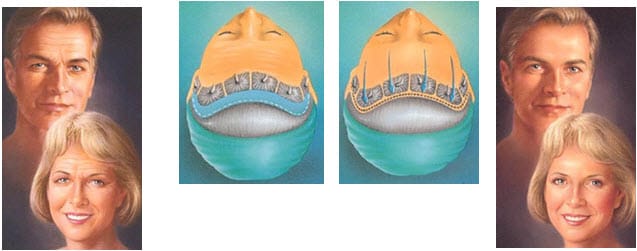
The Percutaneous Suture Suspension Brow Lift ( PSSBL) : It is the new technique that combines the principles of endoscopic brow lift and brow suspension. This technique compose of subperiosteal dissection and adequate mobilization of the forehead, release of lateral ligament to increase mobility of the lateral brow , and release muscles of head of brow. Suture suspension of skin of lateral brow region provides stability to the lift.
This technique is a minimally invasive and quick procedure without the need of an endoscope and can be combined with other facial rejuvenation procedures
After Your Surgery
Classic forehead lift patients may experience some numbness and temporary discomfort around the incision, which can be controlled with prescription medication. Patients who are prone to headaches may be treated with an additional longer-acting local anesthesia during surgery as a preventive measure.
You may be told to keep your head elevated for two to three days following surgery to keep the swelling down. Swelling may also affect the cheeks and eyes--however, this should begin to disappear in a week or so.
As the nerves heal, numbness on the top of your scalp may be replaced by itching. These sensations may take as long as six months to fully disappear. If bandages were used, they will be removed a day or two after surgery. Most stitches or clips will be removed within two weeks, sometimes in two stages.
Some of your hair around the incision may fall out and may temporarily be a bit thinner. Normal growth will usually resume within a few weeks or months. Permanent hair loss is rare.
The Percutaneous Suture Suspension Brow Lift ( PSSBL) : It’s minimally invasive and less time-consuming procedure .Complication of this technique is rare, but temporary such as ;dimple over forehead where the dermal bite is taken and usually settles down in 3-4 weeks, infection at suture site and knot under the scalp incision may protrude out which may have to be removed at a later date.
Getting Back to Normal
Although you should be up and about in a day or two, plan on taking it easy for at least the first week after surgery. You should be able to shower and shampoo your hair within two days, or as soon as the bandage is removed.
Most patients are back to work or school in a week to 10 days. If The PSSBL is taken, most patient are more rapidly back to work. Vigorous physical activity should limited for several weeks, including jogging, bending, heavy housework, sex, or any activity that increases your blood pressure. Prolonged exposure to heat or sun should be limited for several months.
Most of the visible signs of surgery should fade completely within about three weeks. Minor swelling and bruising can be concealed with special camouflage makeup. You may feel a bit tired and let down at first, but your energy level will increase as you begin to look and feel better.