
Ellite II machine involves the use of a specially constructed Xenon flash lamp and focusing optics.
The best candidates for R Ellite II
Ellite II is appropriate for every skin type. But in some cases, there could be some complications such as one who has high sensibility to light or who has been exposed to the sun before the treatment. Dermatologists will consider each individual on case by case basis.
Indication for Ellite II
1. Ellite II for vascular lesions:
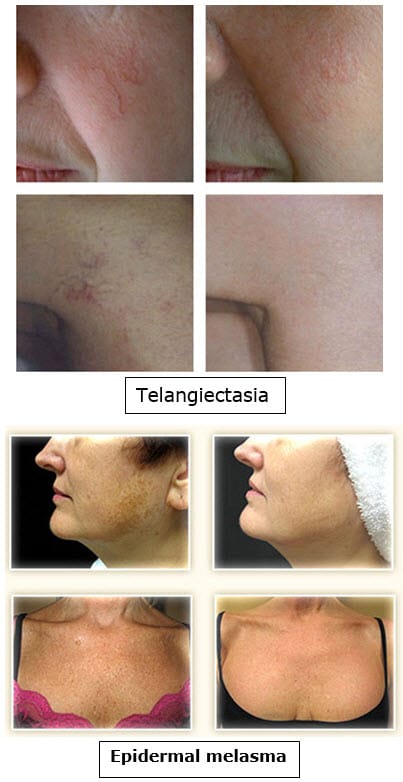
Ellite II is one of the best methods t to correct the disorders of small to medium blood vessels (Vascular Lesions). Vascular lesions include Portwine Strain and Telagiectasia. To clear these vascular lesions, a specific wavelength of light is absorbed by the blood, which damages the lesion. The damaged lesion eventually disappears, removing the appearance of the lesion from the skin. Light energy is delivered over smooth pulse duration, keeping epidermal temperature lower for more comfortable treatments.
2. Ellite II for pigmented lesions:
Ellite II treats pigmented skin such as epidermal melasma, freckles and Becker’s Nevus. Special filter bands of light target the melanin in pigmented lesions, where the light is converted into heat. This heating selectively destroys the pigmented lesion, which is sloughed away; clearing the lesion within two weeks. Specific wavelengths of light can target pigmented lesions on most skin types.
3. Ellite II for Hair removal
The focused, broad-spectrum light is applied to the surface of the skin by way of either a hand-held wand or an articulated arm. This light travels through the skin until it strikes the hair shafts or the bulb (root) of the hair. The bulb is usually where the highest concentration of melanin is located, as opposed to the rest of the hair shaft. As the light is converted to heat energy, the bulb and most of the hair shaft are instantly vaporized. The intense heat radiated by the hair also destroys the hair-producing papilla or the entire hair follicle. It is also claimed that direct light-heat conversion occurs directly in the darker colored capillaries that bring nourishing blood to the follicle.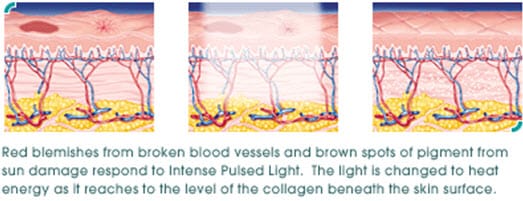
4. Ellite II for Photoageing
Ellite II for Photoageing, sometimes called Photorejuvenation is a dynamic non-ablative process involving the use of IPL to reduce mottled pigmentation and telangiectasias and to smooth the textural surface of the skin. This is due to either the near infrared component of IPL and/or an interaction of blood vessel with release of various endothelial and fibroblastic growth factors. At any rate, there appears to be a collagen remodelling effect with improved skin texture reversing the cutaneous atrophy component of poikiloderma of Civatte. The treatment is generally administered in a series of 3 to 6 procedures in 2-4 week intervals, and patients may resume all activity immediately.
5. Ellite II for Scars
An economical option for correcting facial scarring is Ellite II treatments. Ellite II improves red (Acne Rosacea), raised (Keliod), inflamed, small and pan-shaped scars. This method does show definite improvements in scarred skin. Reju-Light treatments promote new collagen growth. New collagen growth is essential for filling acne scar indentations and smoothing damaged skin.
Contraindication for Ellite II
1. Pregnant woman
2. Patient who has been taking or applying medication that causes sensitivity to light between 515 – 1200 nm. such as taking vitamin A acid (Roaccutane). It is very important to be cautioned to the specific wavelength and rate of light used.
3. For dark (Skin Type 3 – 5) and Black (Skin Type 6) Skin, it is also is very important to be cautioned to the specific wavelength and rate of light used due to their pigmentations that might be getting burnt.
4. Patient with diabetes.
5. Patient with the history of keliod.
6. Patient who has been taking anticoagulants such as Aspirin or Coumadin.
7. Patient who easily bleeds such as leukemia.
Duration
For one treatment, it usually takes 20 – 40 minutes to complete. However, it also depends on the area treated.
Procedure
Reju-Light Procedure depends on the objectives and one’s skin type. First of all, the dermatologist will test for an appropriate and specific wavelength and rate of light used to obtain the optimal results before undergoing the first treatment. The pulses of light produced by IPL equipment are very short in duration, so discomfort and damage to non-target tissues is minor. Most people who undergo IPL epilation only experience slight irritation similar to that of a minor sunburn though under certain circumstances, blisters may occur. However, this pain is minimized by Cooler and will dissipate immediately. During the treatment, light will be released and deeply penetrate through skin layers as the healings take action without damaging the outer most skin. This is often called non-invasive and non-ablative method. After the treatment, patients may resume all activity immediately without being noticed.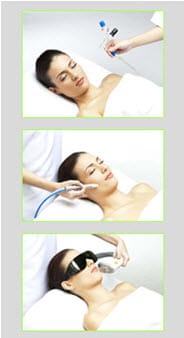
After Treatment
Though discomfort, irritation and burning are minimal, some side effects may pursue as follows:
1. During the treatment, some patients may experience slight irritation similar to that of minor sunburn.
2. The area treated might be sore for 10 minutes.
3. Swelling and redness might be encountered, but will dissipate in less than an hour.
4. Discoloration and pigmentation might occur, but will vanish in 3 – 5 days.
5. Patient may face with the inflammation of hair follicle, but will heal in one week.
6. In case of treatment takes place in the dermis, the softness of skin might alter.